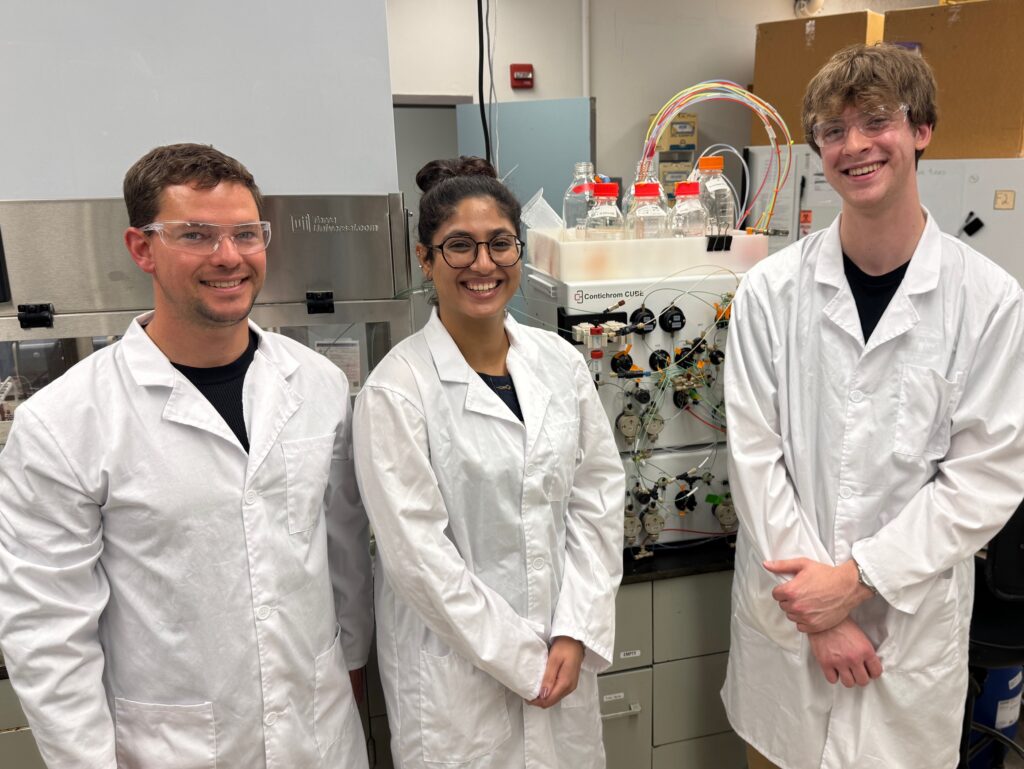
Ben Broedel, CEO, with his interns, Tanya Walia, UMBC ’26, and Cooper McCollum, UMBC ’28
For more than three decades, Athena Enzyme Systems has treated internships as far more than a temporary learning experience. Since its founding in 1994, internships have been central to Athena’s culture, creating a pipeline for industry training, career development, and innovation.
Athena manufactures biotechnology reagents for research, biopharmaceutical, and industrial applications.
Athena’s very first intern was a student from UMBC, and since then, the company has welcomed interns nearly every semester and summer. Many have gone on to full-time careers in biotechnology, manufacturing, research and development, and related industries, either at Athena itself or through the company’s extensive professional network.
“Our internship program is built around the idea of apprenticeship,” said Athena CEO Benjamin Broedel. “Students need real-world experience. They need to understand how science actually works in a professional environment.”
Bridging the Gap Between Classroom and Career
Athena’s internship program has evolved from research-focused projects to a hands-on, skills-based experience centered on laboratory and manufacturing operations. The program emphasizes practical training that prepares students for real-world scientific environments. At Athena, interns participate in nearly every stage of production workflow, learning how to:
- Process customer orders
- Prepare manufacturing documentation and batch records
- Weigh and prepare chemicals and materials
- Conduct quality control testing, including pH and conductivity measurements
- Perform sterile filling procedures in biosafety cabinets
- Label, package, and ship products
The experience gives students direct exposure to how life science products move from manufacturing and testing to documentation and delivery. “It’s not the most glamorous internship,” Mr. Broedel noted, “but it’s incredibly practical. Students leave knowing how to function in a real lab environment.”
Broedel believes many science students graduate with strong theoretical knowledge but limited hands-on laboratory experience. The internship is designed to close that gap by helping students build foundational lab and manufacturing skills while gaining insight into different career paths across biotech, pharmaceutical, research, and academic settings.
For some students, the experience also provides valuable career clarity. “We’ve had students realize they wanted a different career path,” Broedel said, “And that’s valuable too. Internships help students discover what kind of work they actually enjoy.”
Exploring Opportunities: Cooper’s Story
A sophomore studying biology on the pre-med track at UMBC, Cooper McCollum is still exploring exactly where his future in medicine will lead. However, thanks to his Athena internship, he is gaining valuable exposure to laboratory science. Cooper connected with Athena at a bwtech Connects career fair hosted on UMBC’s campus last fall. “I learned a lot during this internship,” he said. “Most significantly, I learned that I really liked lab work.”
Through Athena CEO Benjamin Broedel, Cooper connected with Dr. Harley King, CEO of GrindBio, Athena’s neighbor at bwtech. This introduction led to a summer research opportunity that will allow Cooper to continue building laboratory and research experience.
A Focus on Career Development
Athena’s commitment extends beyond the laboratory. At the conclusion of each internship, the company works directly with students to help them refine resumes, document technical skills, and prepare for future job opportunities. Athena also provides recommendation letters and references for graduate school applications, security clearances, and employment opportunities.
This support has been especially valuable for international students pursuing careers in the United States. “If a student can present a strong recommendation from an American biotechnology company, it can make a huge difference,” Broedel explained.
Broedel emphasizes that interns should always receive tangible value from their experience, whether through monetary compensation, academic credit, or professional development opportunities. Athena frequently partners with programs such as UMBC Career Center’s Shattuck Internship Program and the Maryland Technology Internship Program (MTIP), which help provide paid internship opportunities and administrative support for students and employers alike.
LEARN MORE:
Interns Driving Innovation: Tanya’s Story
While Athena’s internship program is designed to train students, interns have also made meaningful contributions to the company itself.
One standout example is Tanya Walia, a graduate student in data science at UMBC who joined Athena in 2024 through the Shattuck Internship Program. Initially hired to organize decades of company data, Walia quickly became instrumental in advancing Athena’s product development efforts through machine learning.
Using internal formulation data, Walia developed a machine learning model that identifies optimized culture media formulations based on desired outcomes such as protein yield, cell growth, and material costs. During customer testing, the model generated a formulation that outperformed several human-developed versions. “It completely changed the way we think about product development,” Broedel said. “What started as a side project became a real innovation opportunity for the company.”
“I created a machine learning model from scratch based on the needs of Athena’s project,” Tanya explained. “The model helped create a new protein production formulation using Athena’s datasets.” The resulting product—an animal-product-free protein expression media—will be commercially available in 2027. “That was an incredible experience,” she said. “I had never done anything like that before.” Broedel also introduced her to the laboratory side of the business. “He brought me into the lab and taught me how the compounds were created, measured, and tested,” Tanya said.
Expanding Opportunities Beyond Athena
Tanya’s success at Athena quickly opened additional doors. Broedel connected her with another internship opportunity at a Washington, D.C.-based pharmaceutical company, where she worked from spring through summer 2025. Later that year, Athena brought Tanya back onto its project team when they developed a partnership with a German biotechnology company and needed support.
In that role, Tanya worked on fine-tuning a large language model (LLM) to support automated customer outreach and business development. “I fine-tuned the Llama 3.2 model to create a customized chatbot,” she explained. “The system could analyze customer databases, generate personalized emails automatically, and send them to clients.” The tool was designed to help Athena and its German partner strengthen customer engagement and streamline communication efforts.
Growing Professionally — and Personally
While the technical experience was valuable, Tanya says the internship also transformed her confidence and communication skills. “When I first came to the U.S., I was very shy and introverted,” she said. “I didn’t know anyone here.”
She credits Broedel and the Athena team with helping her become more confident and engaged professionally. “He used to tell me, ‘Even if someone is sitting alone, just go talk to them. Start a conversation,” she said. “That advice really changed me.” Tanya gradually became more comfortable engaging with classmates, colleagues, and industry professionals, building both friendships and a growing professional network.
She also credits Athena team members for helping her better understand the healthcare and biotechnology industries. “They helped me understand the science and components behind the products, and helped me learn to navigate documentation, taxes, and everything else,” Tanya said. “Everyone here is incredibly supportive.”
Graduating in May 2026, Tanya is now pursuing opportunities as a machine learning engineer, AI engineer, or data scientist. She is currently working as an AI engineer with a New York-based startup focused on developing generative AI technologies. She has also received interest from employers around the world, including opportunities in Australia and Singapore. Tanya’s story represents exactly what Broedel hopes internships can become: a launchpad for meaningful careers and innovation.
From Internship to Leadership: Shannon’s Story
Shannon Chastain enrolled in UMBC’s Professional Studies biotechnology master’s program in 2019, hoping to restart a scientific career that had been paused for decades while raising a family.
Today, she serves as a leader at Athena Enzyme Systems, overseeing operations, logistics, and scientific support while also pursuing her Ph.D. at UMBC — a journey shaped by the strong connections between UMBC, bwtech@UMBC, and the region’s biotechnology community.
After earning her bachelor’s degree in molecular biology, Shannon briefly worked in biotech research before stepping away from the workforce as her husband’s Navy career moved their family around the country. Years later, after settling in Maryland, she enrolled in UMBC’s Professional Studies program at the Universities at Shady Grove to refresh her skills and reenter the field. “The goal was really to get something current on my résumé so companies would take a look at me again,” she said.
Through the program, Shannon met Dr. Sheldon Broedel, Jr., Ben Broedel’s father, co-founder of Athena, UMBC faculty member, and renowned leader in biotechnology, who connected her with an internship opportunity at Athena. Shannon joined the company in late 2019, initially supporting laboratory experimentation, product development, and market research. She became a full-time employee in 2020 as the company expanded its enzyme and reagent development work.
Today, she works closely with Ben Broedel, managing day-to-day operations while balancing her doctoral research at UMBC. Athena’s flexibility and support have allowed her to continue growing both professionally and academically. Her dual experience in academia and industry has given her a unique perspective on biotechnology. “I work with researchers using these products in the lab, but I also understand the operational side of running a reagent business,” she explained. “It creates a really interesting synergy.”
Shannon credits the collaborative environment at bwtech@UMBC and the university’s strong talent pipeline as major contributors to Athena’s success. “It’s absolutely a gift to be part of this ecosystem,” she said. “Being surrounded by other biotech companies creates opportunities to share resources, solve problems together, and make connections,” she said. “It’s a really unique environment.”
Building Talent Through Mentorship
Broedel also views internships as an investment in the broader scientific ecosystem. The company regularly participates in university career fairs, student panels, and entrepreneurial programs throughout Maryland. He believes local businesses should actively contribute to the communities and universities around them. “Businesses should actively support their local universities and economies,” Broedel said. “For us, internships are part of that responsibility.”
That philosophy has helped Athena build long-standing relationships with institutions including UMBC, Stevenson University, and the University of Maryland, College Park. It has also created a strong network effect for students. In several cases, Athena has directly connected former interns with full-time employment opportunities at other biotechnology companies within its network.
Learning Through Teaching
One of the company’s unexpected discoveries has been how much Athena itself benefits from teaching students. “The act of teaching is the act of learning,” Broedel reflected. “Students ask questions that make us reevaluate our own processes. Additionally, by allowing flexibility for employees and interns to pursue their interests, they tend to add a lot more value to the company.”
Interns have helped identify missing documentation, improve workflows, redesign systems, and strengthen manufacturing procedures simply by asking questions and bringing fresh perspectives into the lab. “They help us build better systems,” Broedel explained. “Sometimes you don’t realize what’s missing because you’ve been doing something the same way for years.”
After more than 30 years of mentoring students, Athena Enzyme Systems continues to view internships not as temporary labor, but as collaborative learning experiences that strengthen both students and the company.